The following FAQs address some of the most common questions discussed during a recent Joint Replacement Q&A webinar with Dr. Richard Bassett, DO, of Granite Orthopaedics. While this is not a comprehensive list of questions about hip, knee, and shoulder replacement, it covers many of the topics participants asked about during the event.
We’re also planning another Joint Replacement Q&A webinar with Dr. Bassett in the near future. Follow Granite Orthopaedics on social media, visit our website, or subscribe to our email newsletter for announcements about upcoming events.
From recovery timelines and nonsurgical treatments to surgical techniques and implant selection, these answers can help you better understand your options.
Recovery After Joint Replacement
1. How long does it take to recover from hip replacement surgery?
Many patients experience significant improvement within 6–8 weeks after hip replacement surgery. Hip replacement recovery is generally faster than knee replacement recovery, although healing times vary depending on overall health, activity level, and other individual factors.
2. How long does it take to recover from knee replacement surgery?
Knee replacement recovery typically takes longer than hip replacement recovery. Many patients make substantial progress within three months, but regaining strength, mobility, and comfort can take longer.
Dr. Bassett emphasizes the importance of managing swelling and following a rehabilitation plan to support recovery.
3. How long does swelling last after knee replacement surgery?
Swelling is a normal part of knee replacement recovery and can persist for several months. Some patients experience residual swelling for up to a year.
However, worsening swelling, significant calf pain, redness, or fever should be evaluated promptly. Sudden shortness of breath or chest pain requires emergency medical attention because these symptoms can indicate a blood clot.
4. What is the Quiet Knee Program after knee replacement?
The Quiet Knee Program focuses on reducing swelling and improving range of motion after total knee replacement.
The program incorporates icing, compression, and specific exercises to help patients regain mobility and function. Consistent participation is important, and physical therapy can provide additional support when needed.
5. Is knee pain or swelling normal a year after knee replacement?
Some patients experience lingering symptoms for several months after knee replacement. However, persistent pain or swelling that is not improving, particularly around or beyond one year after surgery, warrants further evaluation.
Potential causes include infection, ligament problems, and implant-related complications. Dr. Bassett and medical team can evaluate persistent symptoms and determine whether additional testing or treatment is appropriate. Revision surgery is not necessarily required.

Nonsurgical Treatments for Joint Pain
6. What are the alternatives to joint replacement surgery?
Joint replacement is not the only option for managing arthritis and joint pain. Depending on the diagnosis and severity of symptoms, nonsurgical treatments may help reduce pain and improve function.
Options include:
- Anti-inflammatory medications: May help reduce inflammation and discomfort when medically appropriate.
- Cortisone injections: Can provide temporary relief from joint inflammation and pain.
- Hyaluronic acid (gel) injections: May help some patients with knee arthritis, although effectiveness varies.
- Platelet-rich plasma (PRP) injections: Use concentrated platelets from your own blood and may help some patients, although results vary and evidence remains mixed.
- Physical therapy: Can improve strength, flexibility, and joint function.
Dr. Bassett and his medical team considers the underlying joint condition, severity of symptoms, and impact on daily activities when evaluating treatment options.
7. Can cortisone injections damage your joints?
Cortisone injections can provide short-term pain relief, but repeated injections may have drawbacks. Research has raised concerns that frequent cortisone injections into the knee may contribute to cartilage loss in some circumstances.
The potential risks depend on factors such as the joint being treated, injection frequency, and the patient’s condition. Cortisone injections may still be appropriate for some patients when used judiciously.
8. Are gel injections or PRP better than cortisone injections?
No single injection is best for every patient. Cortisone, hyaluronic acid, and PRP work differently, and their effectiveness varies.
- Cortisone injections reduce inflammation and may provide short-term relief.
- Hyaluronic acid injections are intended to improve joint lubrication, but evidence of their effectiveness for knee arthritis is mixed.
- PRP injections use concentrated platelets from your own blood. They may benefit some patients, but results vary, and treatment can involve significant out-of-pocket costs.
The best option depends on the underlying condition, symptom severity, previous treatments, and treatment goals.
9. How can you tell if joint pain is caused by arthritis or another condition?
Joint pain can result from several conditions, including arthritis, cartilage damage, meniscus tears, and ligament injuries.
Dr. Bassett evaluates joint pain through a medical history, physical examination, and appropriate imaging. X-rays can help identify arthritis and changes in joint structure. An MRI may be recommended when additional information is needed to evaluate soft tissues or investigate other possible causes of pain.
An orthopedic evaluation can help identify the cause of your symptoms and determine appropriate next steps.
10. When should you consider joint replacement surgery?
Joint replacement may be appropriate when joint pain and stiffness significantly interfere with daily activities and other treatments no longer provide adequate relief.
The decision depends on several factors, including pain severity, mobility limitations, imaging findings, overall health, and response to nonsurgical treatments.
Dr. Bassett evaluates these factors to help patients understand whether joint replacement or another treatment approach may be appropriate. There is no need to wait until joint pain becomes unbearable before seeking an evaluation.
Joint Replacement Risks and Preparation
11. Is there an age limit for joint replacement surgery?
There is no strict age limit for joint replacement surgery. Overall health, medical conditions, activity level, and ability to recover are important considerations.
Older adults, particularly those over 80, may face increased risks related to anesthesia and other medical conditions. However, age alone does not determine whether someone is a candidate for surgery.
Dr. Bassett considers each patient’s overall health and individual circumstances when evaluating surgical options.
12. Does BMI affect the risks of joint replacement surgery?
Yes. A higher body mass index (BMI) can increase the risk of complications following joint replacement, including infection and wound-healing problems. The risk may increase substantially at higher BMI levels, particularly above 40.
BMI is one factor in assessing surgical risk, not the only one. Dr. Bassett considers the patient’s overall health and other risk factors when evaluating readiness for surgery.
13. What medical conditions can increase the risks of joint replacement?
Several health conditions can affect surgical risk and recovery, including:
- Diabetes: Poorly controlled blood sugar can increase the risk of infection and healing complications.
- Lymphedema: Swelling in the affected limb can complicate wound healing and increase infection risk.
- Vitamin D deficiency: May affect bone health.
- Other medical conditions: Conditions that affect immune function, circulation, or healing may require additional attention before surgery.
Addressing these factors before surgery, when possible, can help improve surgical readiness. Dr. Bassett may recommend coordinating with other healthcare providers to optimize medical conditions before proceeding.
14. Do you need to stop taking medications before joint replacement surgery?
Some medications need to be adjusted before or after joint replacement surgery. These may include blood thinners, immune-suppressing medications, and certain medications used to treat inflammatory conditions.
For example, the timing of medications such as methotrexate depends on the patient’s medical condition, the reason for taking the medication, and the surgical plan.
Never stop or change a prescribed medication without medical guidance. Follow the instructions provided by Dr. Bassett and your prescribing provider regarding which medications to continue, pause, or restart.
15. Should you take calcium and vitamin D after hip replacement surgery?
Calcium and vitamin D support bone health, but supplementation needs vary depending on diet, vitamin D levels, bone density, and medical history.
Patients with osteoporosis may need additional treatment, including prescription medications to help strengthen bones or reduce fracture risk.
Dr. Bassett can discuss bone-health considerations related to joint replacement, and your healthcare provider can help determine whether supplements or osteoporosis treatment are appropriate.
Surgical Techniques and Implants
16. Are robotic-assisted joint replacements better than traditional surgery?
Robotic-assisted surgery can help surgeons plan procedures and perform certain steps with greater precision and consistency.
However, current evidence has not consistently demonstrated better long-term patient outcomes compared with conventional joint replacement techniques. Potential benefits vary depending on the procedure, technology, and surgeon’s experience.
Dr. Bassett considers the patient’s needs and the available evidence when determining an appropriate surgical approach. Robotic assistance is not automatically better for every patient.
17. What is the subvastus approach to knee replacement surgery?
The subvastus approach is a surgical technique used during knee replacement that works around the quadriceps muscle rather than cutting through it.
As discussed by Dr. Bassett, this approach may offer some patients an advantage in early quadriceps function. However, potential trade-offs can include increased swelling or pain, and individual recovery experiences vary.
Differences in early recovery do not necessarily translate into better long-term outcomes. The most appropriate surgical approach depends on the patient’s condition and the surgeon’s clinical judgment.
18. How long do knee replacement implants last?
Many modern knee replacement implants last 15–20 years or longer, although longevity varies from patient to patient.
Factors such as activity level, implant positioning, overall health, and normal wear can influence how long an implant lasts. Some patients eventually require revision surgery because of implant wear, loosening, infection, or other complications.
Dr. Bassett considers implant design, available research, and his surgical experience when selecting an implant for an individual patient.
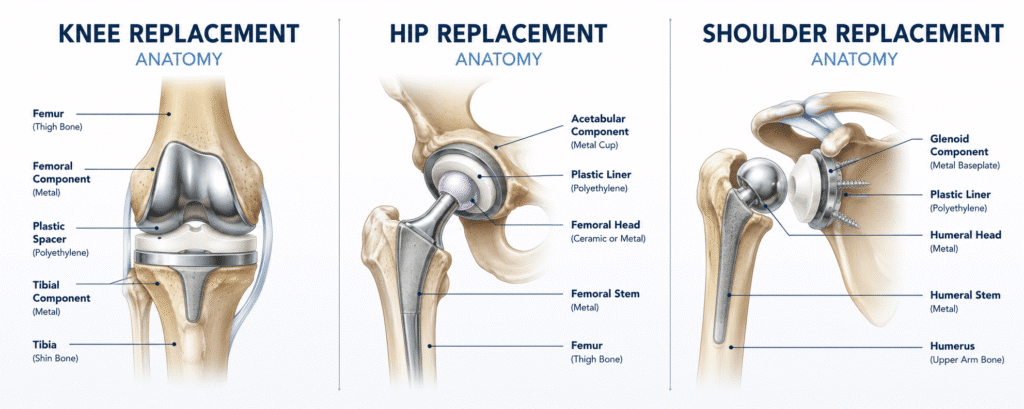
19. What is the difference between traditional and reverse shoulder replacement?
Traditional and reverse shoulder replacements differ in their design and how they function.
Traditional shoulder replacement: Replaces the damaged joint surfaces while relying on a functional rotator cuff to help move and stabilize the shoulder.
Still Have Questions About Joint Replacement?
We weren’t able to answer every question submitted during the Q&A, but we’re working on addressing the remaining questions and hope to schedule another Q&A with Dr. Bassett in the near future.
If you’re considering joint replacement, it’s important to know that your care and surgical plan will be tailored to your individual needs. You’ll have several appointments leading up to surgery to discuss your treatment plan, ask questions, and feel more prepared for the process.
For updates on future Q&A sessions and other educational events, follow Granite Orthopaedics on social media, visit our website, or subscribe to our email newsletter.